

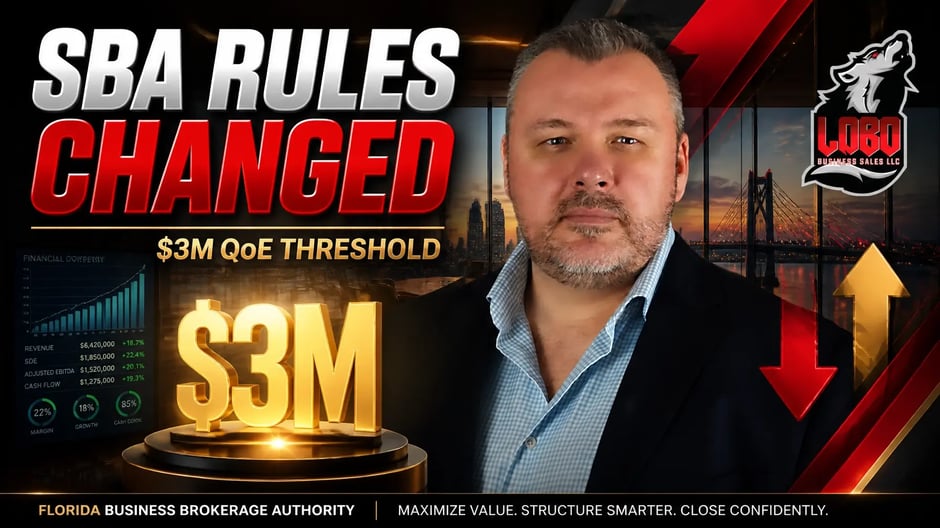
The business-sale process has changed.
Starting October 1, 2026, SBA SOP 50 10 8.1 introduces new standards for 7(a) and 504 lending, including acquisition-financing categories, stricter equity requirements, and a mandatory lender-ordered Quality of Earnings report for qualifying transactions.
For business owners considering an SBA-financed sale, particularly transactions with a business purchase price of $3 million or more, the old strategy is finished:
List the business. Receive inquiries. Accept a promising offer. Assume the buyer will obtain financing.
That process now fails more often because the final decision is not controlled by the buyer or seller. It is controlled by lenders, underwriters, SBA rules, third-party financial professionals, and debt-service calculations.
A buyer can sound serious, sign an indication of interest, and still be unable to close.
The market now rewards preparation before the business is listed, not optimism after an offer appears.
Important: SOP 50 10 8.1 applies to SBA loans receiving an SBA loan number on or after October 1, 2026. Transaction-specific application depends on the loan program, acquisition category, lender interpretation, and project structure. Sellers and buyers should confirm current requirements directly with an SBA lender and qualified legal, tax, and accounting professionals.
What SOP 50 10 8.1 Changes on October 1, 2026
SOP 50 10 8.1 governs SBA 7(a) and Certified Development Company 504 lending procedures.
One of the most important changes is the separation of acquisition financing into defined categories, including initial acquisitions, business expansions, owner buyouts, and other ownership-transition structures.
That distinction matters because the rules are not identical for every transaction.
A complete change of ownership is not evaluated the same way as an owner buyout. A business expansion is not treated identically to an initial acquisition. The buyer’s financing plan must fit the correct category before the purchase agreement is structured around it.
This is where many sellers miscalculate the risk. They negotiate a price first and discover later that the buyer’s lender cannot support the proposed structure.
For a seller in Tampa, Clearwater, St. Petersburg, Lakeland, Brandon, Riverview, Wesley Chapel, or anywhere else in Florida, the financing path must be considered before going to market.
The $3 Million SBA Quality of Earnings Requirement
Under SOP 50 10 8.1, a Quality of Earnings report is required for qualifying initial acquisitions and business expansions when the business purchase price is $3 million or more.
The threshold is generally measured against the business purchase price before:
- Buyer equity injection
- Seller financing
- Other financing sources
- Owner-occupied commercial real estate included separately in the transaction
The report is not simply a document the seller orders and hands to the lender.
The lender must order the QoE, and it must be prepared by an independent financial professional acceptable to the lender. A seller-prepared analysis or buyer-ordered report may not satisfy the SBA requirement.
What a QoE Report Actually Does
A standard profit-and-loss statement shows what the business reported.
A Quality of Earnings report investigates what the earnings actually represent and whether those earnings are sustainable after the transaction.
The analysis may examine:
- Revenue recognition
- Customer concentration
- Recurring versus one-time revenue
- Gross-margin trends
- Unusual expenses
- Owner compensation
- Related-party transactions
- Add-backs and personal expenses
- Working-capital requirements
- Seasonality
- Deferred revenue
- Customer churn for SaaS and digital companies
- Platform dependence for e-commerce businesses
- Contract transferability
- Future earnings reliability
The lender then uses normalized earnings to evaluate debt service and determine whether the proposed purchase price can be supported.
If the QoE reduces the earnings figure, the buyer may need to:
- Contribute more equity
- Reduce the purchase price
- Increase seller financing
- Restructure the transaction
- Find additional collateral or capital
- Abandon the deal
The $3 million threshold is therefore not merely an accounting requirement. It can change the amount the buyer can borrow and the price the seller can realistically receive.

The 10% Equity Injection Has Become a Structural Issue
For an initial acquisition involving a complete change of ownership, the minimum equity injection is generally 10% of total project costs.
Total project costs may include more than the purchase price. Depending on the transaction, they can include:
- Business purchase price
- Closing costs
- Professional fees
- Working capital
- Equipment
- Other eligible project expenses
At least 5% must come from the buyer’s unborrowed cash or equivalent equity.
The remaining 5% may potentially come from limited sources, including a seller note, but only if the note is on full standby for the life of the SBA loan. That generally means no principal or interest payments during the loan term.
A seller note that does not satisfy the standby conditions does not function as the buyer’s equity injection. It may instead be treated as debt, which affects debt-service coverage and total leverage.
Example: A $3.2 Million Business Purchase
Assume:
- Business purchase price: $3,200,000
- Total project costs: $3,400,000
- Required equity injection: 10%, or $340,000
At least $170,000 must come from the buyer’s own unborrowed funds.
Up to $170,000 may potentially come from a properly structured seller standby note or other qualifying limited sources. The exact treatment must be approved by the lender.
This is why deal architecture matters. A seller who casually promises “I can carry 10%” may be offering terms that do not satisfy SBA equity rules.
Why Inquiries Feel Good but Closings Do Not Happen
An inquiry is not financing.
A signed confidentiality agreement is not financing.
An indication of interest is not financing.
Even a letter of intent is not a closing.
The deal must still survive lender underwriting, SBA eligibility review, cash-flow analysis, buyer liquidity verification, valuation review, Quality of Earnings analysis, legal diligence, lease review, licensing, and documentation.
The days of placing an unqualified listing on a business-for-sale website and waiting for financing to solve the transaction are over.
A buyer may claim to have capital but lack the required unborrowed cash. Another may have a strong résumé but insufficient debt-service capacity. A third may support the asking price until the QoE identifies customer concentration, unrecorded liabilities, weak add-backs, or inconsistent financial statements.
The seller may feel encouraged by the volume of inquiries while the probability of closing quietly deteriorates.
Serious sellers qualify buyers before allowing the transaction to consume time, expose confidential information, or disrupt employees and customers.
The Preparation Premium: Clean Books and a Defensible Asking Price
Preparation before going to market is now more important than ever.
A buyer and lender need to understand the business through organized, consistent, supportable information. That means:
- Reconcile financial statements to tax returns and bank activity.
- Document every proposed add-back.
- Separate owner-specific expenses from operating expenses.
- Explain revenue changes and unusual events.
- Identify customer and supplier concentration.
- Review contracts, leases, licenses, intellectual property, and platform accounts.
- Build a management-transition plan.
- Establish whether the business is best analyzed using SDE or EBITDA.
- Price the business using market evidence rather than personal expectations.
SDE, or Seller’s Discretionary Earnings, generally reflects the total economic benefit available to one owner-operator.
EBITDA, or earnings before interest, taxes, depreciation, and amortization, is more commonly used when a business has management depth, institutional operations, and earnings that can be separated from the owner’s personal labor.
A Tampa HVAC company, Lakeland distribution company, Clearwater medical-related business, or Palm Harbor service company may require a different valuation framework than a SaaS or e-commerce company serving customers nationwide.
The asking price must reflect earnings quality, transferability, recurring revenue, management depth, market comparables, and deal structure.
Why a Licensed Florida Business Broker Is Now Paramount
Business brokerage is not residential real estate.
There are millions of real estate agents in the United States, but fewer than 10,000 specialized business brokers. Fewer than 2,000 professionals worldwide hold the Certified Business Intermediary designation from the International Business Brokers Association.
The distinction matters because business sales involve financial analysis, confidentiality, buyer qualification, operational transfer, tax considerations, lender requirements, and negotiation of assets, not merely property showings.
In Florida, any business transaction, including a digital asset such as a SaaS company, e-commerce business, Amazon FBA operation, Shopify store, or online service company, must be represented by someone licensed in the State of Florida. Confirm the licensing and legal requirements applicable to your transaction with the appropriate professionals.
An experienced, licensed business broker can help identify the correct buyer pool, understand local comparable sales, package the financial story, coordinate with lenders, and expose structural problems before they become deal-ending surprises.
The standard is not to generate the most inquiries.
The standard is to create a transaction that can survive underwriting and close.
Start With the Lobo Business Estimator™
The first step is not a public listing.
It is a confidential review of whether the business is ready for the market and whether the proposed exit strategy is realistic.
The Lobo Business Value Estimator™ is an entryway for owners who need an initial value range based on business type, revenue, SDE, recurring revenue, customer concentration, owner dependence, financial-record quality, and transferability.
It is not a formal business appraisal or Broker Price Opinion. It is not a guarantee of market price. It is a starting framework for an exit discussion.
Business owners considering a sale in Tampa, Brandon, Riverview, Wesley Chapel, Lutz, Odessa, Plant City, New Port Richey, Spring Hill, Lakeland, or statewide digital markets can use the estimator before deciding whether deeper paid analysis is warranted.
The $1,500 Broker Price Opinion: The Ante Before You Play
For most Main Street and upper Main Street businesses, the next step is a professionally prepared $1,500 Broker Price Opinion.
The BPO is not a formal appraisal. Formal business appraisals commonly start at approximately $4,000 to $5,000 and can increase substantially depending on complexity.
The BPO is a scaled, locally relevant, data-backed analysis designed to establish a defensible market position. It can incorporate:
- Recent comparable sales
- Recast financial statements
- SDE or EBITDA analysis
- Economic conditions
- Business-model characteristics
- Transferability and owner dependence
- Recurring revenue and customer concentration
- A realistic asking-price range
Think of the BPO as the ante in a poker game.
The report allows the owner to see the cards: the business’s probable market position, strengths, weaknesses, and financing obstacles. The owner can then decide whether to play the hand and go to market, or fold temporarily, improve the business for 6–12 months, and return with stronger evidence.
That is not hesitation. It is control.
Lobo Business Sales LLC is not for every business or every seller. Few companies meet the standards required for a properly positioned transaction.
Owners can review LoboBusinessSales.com’s YouTube channel for additional guidance, then determine whether the business qualifies for a confidential discussion.
Start with the Lobo Business Value Estimator™, then schedule a confidential 15-minute consultation. If the business is a fit for the firm’s standards, order the $1,500 BPO before exposing the company to the market.
FAQ: SBA Lending Changes and Business Exits
Does every business sale over $3 million require a QoE?
No. The requirement applies to qualifying SBA-financed transactions, particularly initial acquisitions and business expansions. Owner buyouts and other structures may be treated differently. The lender determines the applicable requirements.
Who orders the SBA Quality of Earnings report?
The lender orders the report, and it must be prepared by an independent financial professional acceptable to the lender.
Can a seller note satisfy the full 10% equity injection?
Generally, no. At least 5% must come from the buyer’s unborrowed funds. A properly structured seller standby note may potentially cover the remaining 5%, subject to lender and SBA requirements.
What does “full standby” mean?
A seller note counted toward equity generally must prohibit principal and interest payments for the life of the SBA loan. The lender must approve the documentation.
Is the Lobo Business Estimator™ a formal valuation?
No. It provides an estimated value range for initial planning. It is not a formal appraisal, BPO, fairness opinion, or guarantee of market price.
Why obtain a BPO before listing?
A BPO helps establish a defensible asking price using comparable sales, recast financials, business-model analysis, and economic context. It also identifies weaknesses before a lender or buyer discovers them.
Can a real estate agent sell my business?
A real estate license alone does not provide the specialized training or business-broker qualification needed for a complex business sale. Use a properly licensed Florida business broker and qualified legal, tax, and lending professionals.

Licensed Business Broker services provided by
Dave Britton, Certified Business Intermediary (CBI)
Lobo Business Sales LLC
Member: BBF & IBBA
Supporting small businesses throughout Tampa Bay
Veteran-Owned Business.



Leave a Comment